What is chiropractic?

Chiropractic is a gentle, manual therapy that is not meant to replace classical veterinary medicine, but rather to complement it.
The former approach that a joint must be realigned is now outdated.
Joints that are in their normal position but do not move sufficiently, potentially leading to various restrictions, are treated.
While conventional medicine often can only address symptoms, chiropractic can, in many cases, address the underlying cause or serve as a preventative measure.

Influences on the nervous system

The main influence of chiropractic care pertains to the nervous system.

There are countless sensors for body perception distributed in small muscles around the spine.

If these muscles do not move appropriately in a certain area, not enough information reaches the brain from that area.

Through chiropractic treatment, these muscles are stretched/reactivated, and the nervous system receives a complete message about the body again.

This improves body awareness, and the animal moves in a more controlled and secure manner.

Additionally, larger nerves exit the spinal cord in the area of the spine, which supply information to the muscles of the limbs, for example. If these nerves are subjected to blockages and increased pressure, the flow of information is reduced, and the muscles receive less input, leading to varying degrees of atrophy.
The main influence of chiropractic care pertains to the nervous system.

There are countless sensors for body perception distributed in small muscles around the spine.

If these muscles do not move appropriately in a certain area, not enough information reaches the brain from that area.

Through chiropractic treatment, these muscles are stretched/reactivated, and the nervous system receives a complete message about the body again.

This improves body awareness, and the animal moves in a more controlled and secure manner.

Additionally, larger nerves exit the spinal cord in the area of the spine, which supply information to the muscles of the limbs, for example. If these nerves are subjected to blockages and increased pressure, the flow of information is reduced, and the muscles receive less input, leading to varying degrees of atrophy.

Influences on the musculature

Joints receive their stability mainly from the surrounding muscles and tendons, accounting for 80%.

When the nerves are relieved, the previously undernourished muscles receive more input, become stronger again, and thus support the joints they surround, which also relieves already damaged joints.
Joints receive their stability mainly from the surrounding muscles and tendons, accounting for 80%.

When the nerves are relieved, the previously undernourished muscles receive more input, become stronger again, and thus support the joints they surround, which also relieves already damaged joints.

Influences on the joints

If a joint moves less, more stress is placed on the surrounding joints, which can lead to long-term damage.

The cartilage as a joint cushion depends on the movement of the joint to receive nutrients. If more movement occurs again through treatment, the cartilage becomes healthier and more stable, thereby relieving the bones.
If a joint moves less, more stress is placed on the surrounding joints, which can lead to long-term damage.

The cartilage as a joint cushion depends on the movement of the joint to receive nutrients. If more movement occurs again through treatment, the cartilage becomes healthier and more stable, thereby relieving the bones.

When can chiropractic help?

When individual joints are blocked, other joints become overloaded as they have to compensate for the blocked joint. If all joints perform their functions accordingly, overloads can be avoided, and overstrained areas can recover.

The sensors for body sensations, which are adressed by the adjustment, send information to the brain faster than the pain fibers. This "overwrites" the sensation of pain.

Obvious lameness often only occurs when the animal can no longer compensate. Often, an uneven gait precedes the limping. Chiropractic care can already be applied here, before there are, for example, obvious radiological changes.

Due to the anesthesia, a certain protective stabilization of the muscles is also lost, resulting in less support for the joints during this time. This can lead to new blockages.

Some areas may be blocked to the extent that active or passive movement is not possible, or is not sufficient. Therefore, muscle building cannot occur here either. By alleviating the blockage, physiotherapy can subsequently be more successful.

If the brain does not receive information from a specific part of the body, it "creates" information from that area. This information can also be unfounded pain.

If the nerves that exit the spinal cord through the spine are compressed, they transmit less information or become continuously activated, which can lead to weakness or sensitivities.

Changes in nerve transmission disrupt the unconscious nervous system, which can lead to incorrect impulses being generated.

The sympathetic nervous system (the "stress" nervous system) runs partially directly beneath the spine. Blockages here also affect the sympathetic nervous system, which alters the activity of glands, such as the anal glands.

If the sympathetic nervous system is kept permanently active, it inhibits the parasympathetic nervous system (the "rest" nervous system), which is responsible for digestion.

FAQs

After the data collection and preliminary report, I examine your animal in a standing position and in motion, and I palpate the body broadly. During this process, any obvious changes such as swelling, increased warmth, or hypersensitivity are already noted.
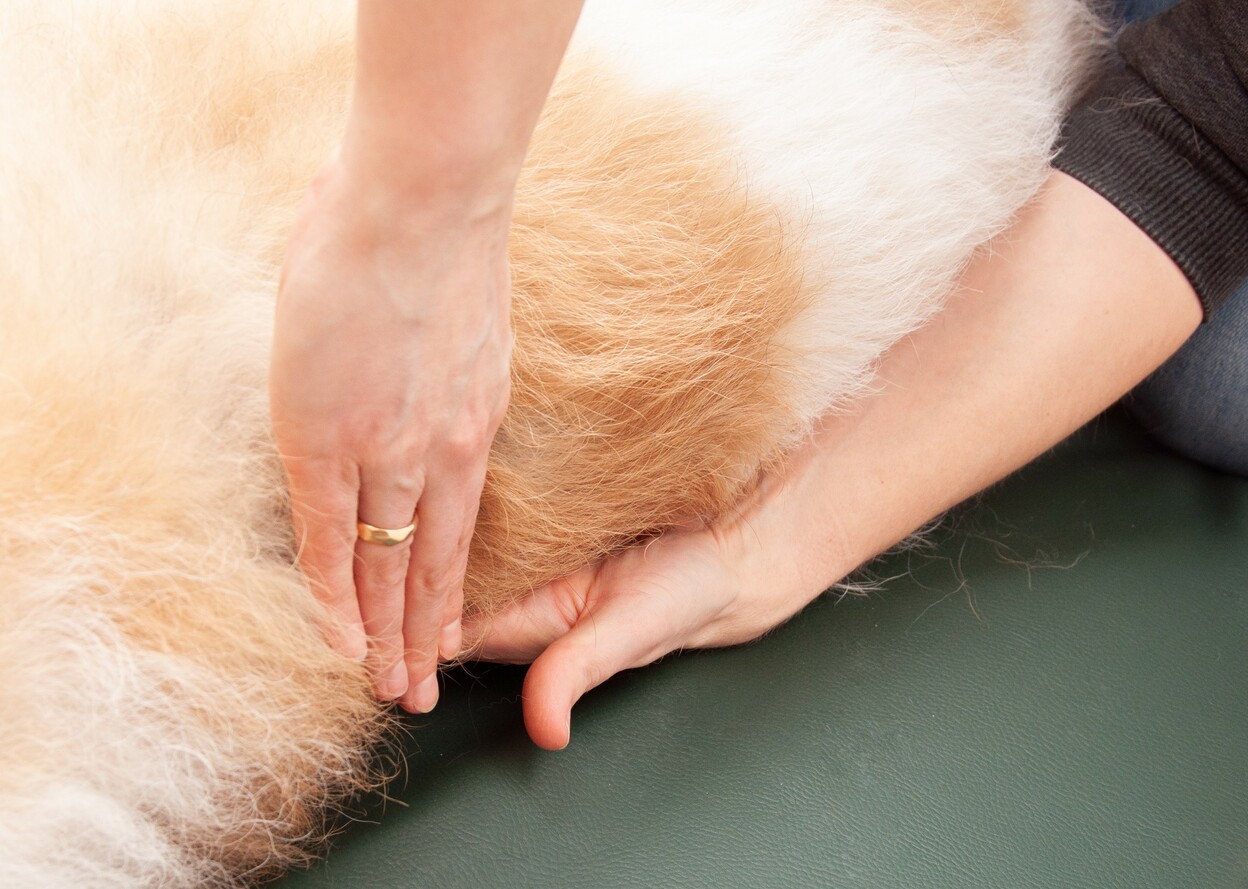
Subsequently, the joints are gently moved individually to assess their range of motion. If a joint is restricted in its movement, it is activated by an impulse, known as an adjustment.
Unlike the classic chiropractic practices for humans, this rarely produces a sound and is performed without using a long lever.
The focus is on the spine, as it contains the majority of receptors for body perception. However, the joints of the limbs are also tested and treated as needed.
Everything is discussed again afterward, and you will receive a report via email that includes a visual documentation of the results. If you are to perform exercises afterward, these will also be discussed.
Depending on the findings, multiple treatments may be necessary to achieve long-term success.


An adjustment (an impulse with high speed and low force within the anatomical range of motion) targets a specific joint that is not moving within its normal range.
Your pet should be rested for the remainder of the day. Many of them are very tired afterward and need a lot of sleep.
Chiropractic is a very safe method, as only a specific joint is treated with a quick impulse using little force per adjustment.
Muscle soreness may occur in the next two to three days.
In cases of acute, severe lameness with strong pain or paralysis, please contact your veterinarian immediately. 
After accidents, it is also necessary to see your veterinarian right away.
In both cases, chiropractic care may be beneficial during recovery or rehabilitation.
I want you and your pet to feel well taken care of with me, which also includes transparency regarding costs.
As a veterinarian, I am bound by the fee schedule for veterinarians (GOT), according to which all services are billed.
The cost for an initial treatment is 100 euros and for a follow-up treatment 80 euros.
Should further examinations or additional veterinary procedures be necessary during the treatment, I will, of course, discuss these with you beforehand and then bill them according to the GOT.
Payment is made immediately after the treatment – very easily in cash or by EC card.
There are no chiropractic emergencies per se. In cases of acute lameness, severe pain, or even paralysis, your pet's veterinarian or a clinic is the right contact.

As a veterinarian, I am obliged to provide emergency services, but do not have a veterinarian pharmacy or diagnostic capabilities such as X-rays, etc.
I am also available for consultations for my clients at my number during nights, weekends, and holidays, but please keep in mind that in such cases, a fee adjusted for emergency services will be charged for the consultation.